simplifying video game design with board games

i care a whole lot about user experience. it sometimes feels like that's all i think about when working on development. how can i make sure that a player feels like the game/menu interactions are intuitive and their goals are clear, while also using as little text as possible. video games are complicated... VERY complicated. and finding a way to achieve your grand creative vision for a huge amazing game is basically totally at odds with the act of simplifying things. but by refining your ideas, they can get better. eventually a bunch of totally different ideas can start to click together into a cohesive experience. i have found recently that there is a lot to be learned from board games, as a video game developer. that might sound obvious to some of you, but it was a bit of a revelation to me!

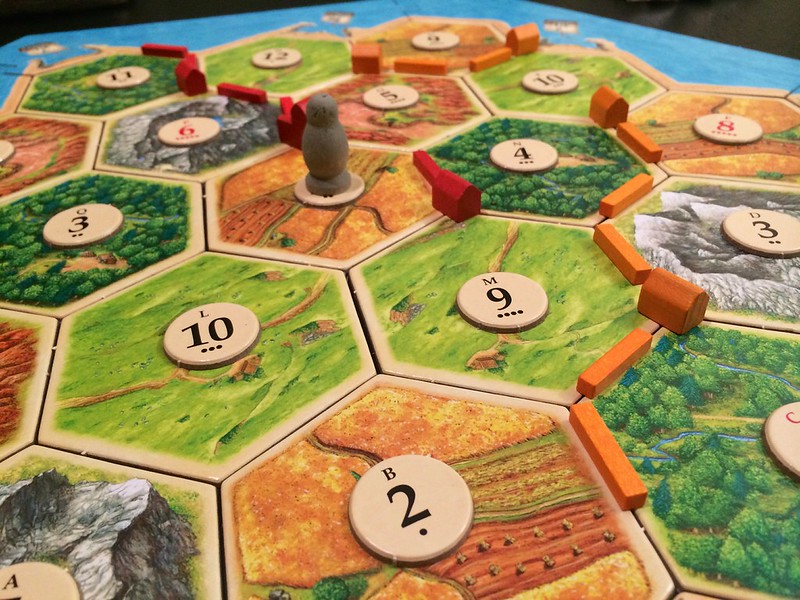
a photo of the board game "Settlers of Catan" taken by Via Tsuji
board games revolve around simple pieces, cards, and boards. they can use text on cards but not too much. players can have resources in the form of cards, tokens, or sliders. the rules say things can happen when a player does a certain action, such as moving their piece or using a certain card. or the rules can say something happens when certain tiles are adjacent to one another. the rules are often simple individual mechanics, easy enough to explain in text on the cards themselves. with the help of some icons on the cards a player only needs to be shown one or two turns of the game to understand the strategy involved, and start coming up with their own way of playing the game within those rules.
video games are able to do so much more because we can use the computer to manage and play out far more complex scenarios. the computer can keep track of countless totally different tasks. it is easy to get absorbed in that potential, but i find every time i do i get sick to my stomach and i have to sit down and figure out how to simplify things. designing video games like board games doesn't mean they have to be as limited as board games, but it does give a good frame of mind for how to design for simple rules which bring about complex interactions!
start asking yourself what your game's board, cards, pieces, and rules are. with video games, we can have boards that are worlds which animate and move and change and be dynamic in ways that would take hours for players of a board game to manage. the cards are the choices the player or other characters can make. the pieces can be controlled by a computer that can automatically control dozens (or even hundreds) of individual, similar or disparate behaviors! and the rules define what happens when specific cards are used, or pieces are in certain spots with relation to one another and the overall board.
examples
here are some examples of how this mindset helped me and bscit refine our ideas working on the new game we are making:
currency as tokens
instead of having currency values in the hundreds or even thousands, simply having tasks that give the player one, two, or three units simplifies things for the player and the developers. rather than having to think about how to balance a wide range of possible point values you could earn for certain actions, it becomes as easy as asking a simple question to determine what score to assign. is this action easy? one point. is it hard? three points! by doing so, the player also has more potential for strategizing, as they now have a clearer ability to comprehend the potential rewards of doing various tasks. it also establishes some clear restrictions which make it easier to balance how frequently these different tasks can be done.
grid-based movement
instead of having fuel that drains continuously, making the fuel be a set of "tokens" the player has, which they spend to make moves, helps the player be in the mindset of using travel as a resource. for us, this idea quickly evolved into giving the player the ability to travel across multiple tiles at a time (up to a limit determined by their "speed") on a single turn. now all of a sudden the entire level map becomes a sort of puzzle, where the player is strategizing their resource usage and turns. deciding where to put certain locations on the level map becomes a lot easier to figure out when this strategy is in mind. not all games should be grid-based or turn-based, and for us this idea had some side effects on other aspects of the game we did not find favorable, so we chose to scrap the idea. there are benefits to knowing what does not work, as it can help you find what does work!
spatial puzzle inventory
rather than having a list of resource types with various quantities, the resources can be stored as shaped pieces in a spatial puzzle. for our game this idea enhances all of the other systems in the game, while also being simpler for players to understand. it introduces opportunity costs as holding onto some items prevents you from being able to hold some other items. it also opens the door for making all kinds of different, unique resources which we could not do when we only had some icons and numbers indicating how many of that resource you had. what about an item with a timer on it which can cause you to lose other items if you do not use it in time? or an item that an can be given to you which cannot be moved or rotated, blocking you from using those slots until you get rid of them? how about items the player can grab and use to give themself a boost? now the player has to face the fact that holding onto useful boost items also prevents them from being able to carry other resources that might help them progress through the scenario. the items have become "cards", which have their own rules listed on them, and can be used for specific gameplay needs.
final thoughts
there's a lot to be learned from board games which are forced to rely on player's running the game themselves. even if i'm not making a game that plays like a board game, thinking of gameplay features as parts of a board game has really helped me refine my ideas, and hopefully it can help you too!
i considered leaving out the section on the turn-based grid movement because it ultimately went unused, but i felt like it was still a key point at which i finally started to feel some confidence in the direction the prototype was heading. even though things changed after that, it was something that we chose to not do in order have a different kind of gameplay experience. the lesson i learned from that was that not everything has to be "the best" way of doing it. my mind said "yeah turn-based grid movement makes all these other parts of the game fall into place! this rocks! this will be so fun!" but then our hearts told us "but having more freedom to explore and having to manage time in real-time is fun too" and ultimately we went with our hearts. so don't treat my advice as some kind of master solution to all your problems... or anyone's advice for that matter! make your game from the heart, follow where it leads you. anyone can follow a set of rules to make something that is "great" according to all the "rules." only you can make something from your heart! <3